CEREC® One-Visit Restorations at Realtooth
Your Tooth.Digitally Scanned. Custom Designed. Restored in One Visit When Clinically Appropriate.
Traditional crown treatment may involve:
Tooth Preparation Conventional Impression Temporary Crown External Laboratory Second Appointment Final Crown
CEREC® digital dentistry can change that journey.
In suitable cases, Realtooth can bring the major restorative steps together into a single integrated workflow:
often within one appointment.
CEREC® is Dentsply Sirona's chairside CAD-CAM platform designed specifically to support single-visit restorative dentistry.
But Realtooth's advantage is not simply owning a CEREC machine.
Realtooth has built an entire digital restorative ecosystem:
4 CEREC® Digital Workflows
supported by
20 Digital Intraoral Scanners
across the Realtooth network.
This allows digital dentistry to become an organisational capability rather than a technology sitting in one room.
Scan anywhere within the Realtooth digital ecosystem. Plan intelligently. Manufacture with control. Restore precisely.
What Is CEREC®?
CEREC® is a digital chairside restorative system that allows dentists to digitally scan a prepared tooth, design a customised restoration and manufacture it using CAD-CAM technology.
Dentsply Sirona describes CEREC as a workflow designed to enable permanent restorations to be delivered in a single visit in suitable clinical situations.
Depending on the tooth, clinical indication, restorative material and treatment plan, CEREC workflows may be used for restorations such as:
- Dental crowns
- Inlays
- Onlays
- Overlays
- Selected veneers
- Selected bridges
- Selected implant restorations
- Other CAD-CAM restorations
CEREC's current ecosystem supports multiple restorative indications and a broad range of validated materials.
What Makes Realtooth Different?
Many clinics may have access to a scanner or milling unit. Realtooth has developed CEREC as a scaled digital dentistry workflow.
4 CEREC® Workflows
Our restorative infrastructure allows multiple Realtooth teams to work through digitally integrated restorative pathways.
20 Digital Scanners
Our network of intraoral scanners allows digital dental records and restorative scans to be captured across the Realtooth ecosystem.
In-House CAD-CAM Capability
Selected restorations can move from clinical scanning to digital design and manufacturing within our own digital workflow.
Multispeciality Treatment Planning
When the tooth also requires:
- Root canal treatment
- Gum treatment
- Implant dentistry
- Smile design
- Bite rehabilitation
the restorative workflow can be coordinated with the appropriate Realtooth team.
The Realtooth advantage is not simply same-day manufacturing. It is control over the complete restorative journey.
The Realtooth CEREC® One-Visit Workflow
A suitable restorative case may move through:
Diagnose
Understand what is wrong with the tooth.
Preserve
Determine how much natural tooth structure can be retained.
Prepare
Prepare only what is clinically necessary for the selected restoration.
Scan
Capture the tooth and surrounding dentition digitally.
Design
Create the restoration digitally according to tooth anatomy and bite.
Manufacture
Mill the restoration using the appropriate CAD-CAM material and workflow.
Finish
Characterise, polish, glaze or sinter according to the selected restorative material.
Verify
Evaluate fit, contacts, bite and aesthetics.
Bond / Cement
Place the definitive restoration.
Potentially within a single clinical visit in an appropriate case.
Realtooth USP: 20 Digital Intraoral Scanners
The first step in digital restorative dentistry is capturing accurate information.
Realtooth has invested in a broad digital scanning ecosystem with 20 intraoral scanners across its network.
Digital scanning can capture a three-dimensional representation of:
- Prepared tooth
- Neighbouring teeth
- Opposing teeth
- Bite relationship
- Existing restorations
- Dental arch
This means the restorative design begins with a detailed digital record rather than simply a physical impression.
Digital Scanning vs Conventional Impressions
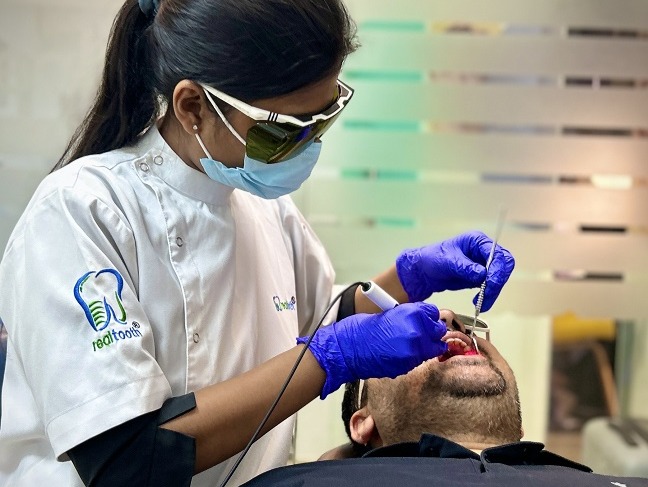
Traditional crown fabrication often requires impression material placed inside the mouth.
For suitable CEREC cases, digital scanning can replace that stage.
Potential patient advantages include:
- No conventional impression tray in many cases
- Immediate digital visualisation
- Digital transfer of information
- Easier communication between clinical and digital teams
- Ability to evaluate the scan before manufacturing
Dentsply Sirona describes CEREC's single-visit workflow as allowing permanent restorations without conventional impression trays in suitable cases.
Realtooth USP: Digital Design Before Manufacturing
Once the scan is complete, the restoration is designed digitally.
The design can be customised for:
- Tooth shape
- Remaining tooth structure
- Neighbouring teeth
- Contact points
- Opposing teeth
- Bite
- Restorative space
- Functional requirement
- Aesthetic requirement
Current CEREC workflows allow clinicians to customise restoration proposals by modifying characteristics such as form, shape and position before manufacturing.
The restoration is not taken from a box. It is designed for that particular tooth.
Realtooth USP: In-House CEREC® Manufacturing
After digital design, the restoration can enter the manufacturing stage. CEREC Primemill® is designed for chairside production of restorations using modern milling and grinding strategies and supports a range of restorative materials and indications.
For the patient, bringing design and manufacturing into an integrated Realtooth workflow can mean:
CEREC® Primemill
CEREC Primemill is one of the key manufacturing technologies within modern CEREC digital dentistry. According to Dentsply Sirona, Primemill combines modern CAM strategies and chairside milling technology for fast, precise production of restorations across multiple indications.
At Realtooth, the value is not simply that a machine can mill a crown. The value is the entire sequence:
- Clinical Decision
- Digital Scan
- Design
- Material Selection
- Manufacturing
- Dentist Verification
CEREC® SpeedFire and Zirconia Restorations
Some restorative materials require an additional heat-processing or sintering stage.
CEREC SpeedFire® integrates with the CEREC workflow and can allow selected full-contour zirconia crowns to be processed for placement within a single appointment. This can make one-visit zirconia restoration possible in appropriately selected cases.
Again: Same-day treatment depends on the tooth, material and clinical condition—not simply on having the machine.
What Restorations Can Potentially Be Made With CEREC®?
Depending on the clinical condition and selected material, Realtooth may consider CEREC workflows for:
Crowns
For teeth requiring substantial structural protection.
Inlays
For selected cavities where a digitally fabricated restoration provides an alternative to a large direct filling.
Onlays
For teeth requiring restoration of one or more weakened cusps while preserving more natural tooth structure than traditional full-crown preparations.
Overlays
For more extensive restorative coverage in selected teeth.
Veneers
Selected cosmetic cases may be suitable for digitally designed ceramic veneers.
Implant Restorations
Selected implant crowns and restorative components may be incorporated into a digital CAD-CAM workflow.
Selected Bridges
Certain CEREC milling workflows support bridge indications depending on material, span and clinical requirements.
One-Visit Dental Crown
A common use of CEREC at Realtooth is the one-visit dental crown. A suitable case may follow:
Examination
Initial clinical evaluation and assessment of the target tooth.
Tooth Preparation
Precise tooth shaping to accommodate the restoration.
Digital Scan
Capturing a fast, accurate 3D digital impression without conventional trays.
CEREC Design
Custom 3D CAD design of your crown tailored specifically to your tooth.
Material Selection
Selecting the ideal ceramic or zirconia material for strength and aesthetics.
CEREC Manufacturing
High-precision chairside milling of the designed restoration.
Finishing
Sintering, polishing, and shade matching for a natural appearance.
Fit & Bite Check
Verifying alignment, contact points, and occlusion for ultimate comfort.
Final Crown Placement
Permanent bonding of the restoration in a single appointment.
Why Avoiding a Temporary Crown Can Matter
Traditional crown treatment may require the prepared tooth to be protected with a temporary restoration while the permanent crown is manufactured.
Temporary crowns can somecheck:
The Single-Visit Advantage:
Where a definitive CEREC restoration can be completed safely in the same visit, the patient may move directly from tooth preparation to the final restoration.
Realtooth USP: Single-Visit Does Not Mean Standardised
Speed should never result in every patient receiving the same restoration.
At Realtooth, CEREC design can still be customised according to:
Our Restorative Philosophy:
One visit refers to the workflow—not to one-design-fits-all dentistry.
Material Selection Still Matters
CEREC is a manufacturing platform—not one single dental material. Different restorative materials have different properties.
Depending on the case, the dentist may consider factors such as:
CEREC Primemill supports a broad range of material options from Dentsply Sirona and validated partners.
The Realtooth Core Principle:
We don't choose the material because it is fastest to manufacture. We choose it because it suits the tooth.
Specialised Restorative Materials
Tailored material options focused on strength, aesthetics, and long-term durability.
Zirconia Restorations
Zirconia may be considered in selected situations because of characteristics such as:
- Strength
- Fracture resistance
- Biocompatibility
- CAD-CAM compatibility
- Aesthetic possibilities
Single-Visit Processing:
Using integrated milling and SpeedFire workflows, selected zirconia restorations can be manufactured and processed within a chairside single-visit environment.
Ceramic Restorations
Modern ceramic materials may be particularly useful when aesthetics are important. The treatment team may consider:
- Shade
- Translucency
- Surface texture
- Adjacent teeth
- Smile position
- Functional load
Individualised Selection:
The appropriate ceramic is selected according to the individual restorative requirement.
Comprehensive Restorative Planning
At Realtooth, every restorative decision balances speed, strength, and individual tooth requirements to deliver predictable long-term results.
In multidisciplinary cases, the Realtooth workflow combines:
Clinical Decision + Digital Scan + Custom CAD Design + Precise CAM Manufacturing
- Material Suitability: Selecting the ideal material (Zirconia or Ceramic) based on bite forces and location.
- Anatomical Customisation: Tailoring shade, shape, and contours to fit naturally.
- Enamel Preservation: Ensuring minimal invasive tooth preparation.
- Single-Visit Efficiency: Eliminating temporary crowns and long laboratory turnaround check when clinically appropriate.
This is one of the distinct advantages of receiving CEREC restorative treatment within a comprehensive multispeciality dental organisation.
Realtooth USP: Conservative Digital Restorations
One important benefit of digital restorative dentistry is that a damaged tooth does not always need to jump directly from a Large Filling to a Full Crown.
In selected teeth, digitally fabricated options allow more healthy tooth structure to be retained:
Inlays
Precise custom-fit restorations for damage confined within the tooth cusps.
Onlays
Extends over one or more cusps to preserve healthy natural structure.
Overlays
Covers the entire biting surface while conserving natural underlying tissue.
The restoration should always match the exact amount of tooth damage.
Realtooth's Conservative Dentistry Philosophy:
CEREC® After Root Canal Treatment
A root canal-treated tooth often requires additional restorative protection depending on how much natural structure remains. Because Realtooth provides both root canal and digital restorative care, selected teeth may move through an integrated workflow.
In appropriate cases, this integrated workflow can significantly reduce the number of separate treatment visits required.
But Not Every RCT Tooth Should Receive an Immediate Crown
This distinction is important.
If a tooth has:
the dentist may recommend monitoring or staged treatment before definitive restoration.
The availability of one-visit technology should never force a tooth into one-visit treatment.
CEREC® for Inlays and Onlays
A large filling may somecheck weaken remaining tooth structure. Traditionally, patients may be advised to receive a full crown, but in selected cases, a digitally designed inlay or onlay may provide another option.
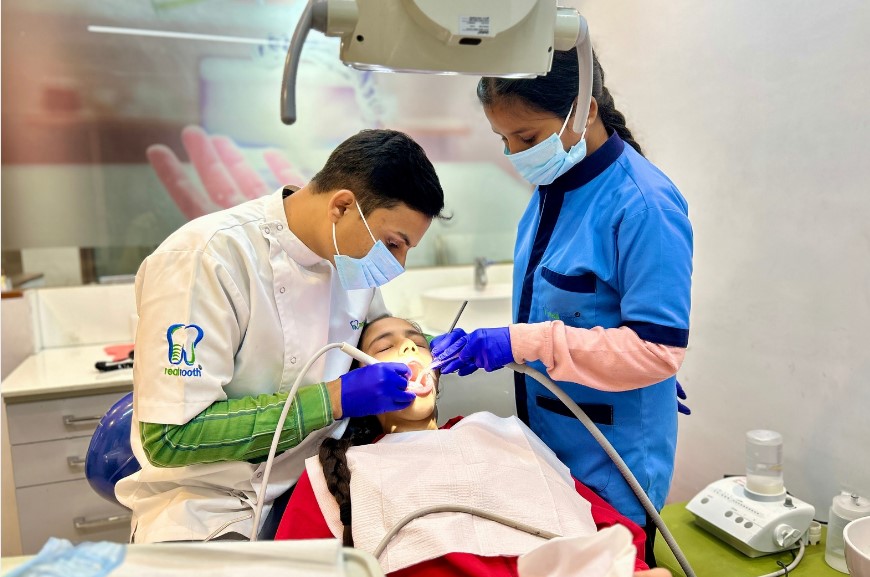
This can allow the dentist to:
- Replace the damaged portion
- Protect weakened cusps when required
- Preserve more healthy enamel
- Avoid unnecessary full-tooth reduction
This is one of the areas where digital restorative dentistry can support more conservative treatment planning.
CEREC® Veneers & Smile Enhancement
Selected cosmetic cases may also benefit from accelerated digital restorative workflows. Depending on the case, Realtooth may integrate:
Digital Smile Assessment
Intraoral Scanning
Veneer Design
CEREC CAD-CAM Manufacturing
Clinical Customisation
This can contribute to single-visit or accelerated smile transformation in carefully selected patients.
Speed when appropriate. Customisation always.
CEREC® Implant Crowns
Digital workflows can also be valuable in implant dentistry.
Implant Position
Digital Scan
Customised Prosthetic Design
CAD-CAM Manufacturing
Bite and Tissue Assessment
Final Implant Restoration
Realtooth's implant and digital teams can therefore work within one restorative ecosystem.
Why Bite Matters in One-Visit Dentistry
A crown can be produced quickly. That does not mean it should be cemented quickly without assessment.
Before final placement, the Realtooth team evaluates:
- How the restoration contacts neighbouring teeth
- How it meets the opposite tooth
- Whether it feels high
- Functional chewing contacts
- Restoration stability
Fast manufacturing does not replace careful clinical verification.
Realtooth USP: Four CEREC® Workflows
Realtooth's investment in four CEREC digital workflows is significant because it allows chairside digital dentistry to operate at scale.
Standardised Digital Protocols
Trained Clinical Teams
Multiple Digital Entry Points
Integrated Manufacturing Capability
Quality-Control Systems
Shared Digital Expertise
This supports Realtooth's long-term goal of making advanced digital dentistry repeatable across the organisation.
Realtooth USP: 20 Scanners, One Digital Ecosystem
Our 20-scanner infrastructure means digital dentistry can begin across multiple patient journeys.
The scan may support:
Scan once. Understand more. Use the information intelligently throughout the patient's dental journey.
Technology + Teamwork
CEREC dentistry is somecheck marketed as if the machine creates the treatment.
At Realtooth, there are several layers behind every successful restoration:
Clinical Dentist
Diagnoses and prepares the tooth with clinical precision.
Digital Scanning Team
Captures accurate, highly detailed digital 3D intraoral information.
Restorative / Prosthetic Expertise
Determines design, material selection, and functional requirements.
Digital Design Team
Supports CAD-based restorative development where complex modeling is required.
Manufacturing Workflow
Produces the selected restoration with high precision milling systems.
Treating Dentist
Evaluates the restoration clinically for fit, bite, and aesthetics before final placement.
Digital dentistry works best when people and technology work together.
Why Choose Realtooth for CEREC® One-Visit Dentistry?
Combining advanced technology, scaled infrastructure, and multi-disciplinary clinical expertise.
4 CEREC® Workflows
A scaled digital restorative infrastructure rather than a single chairside setup.
20 Digital Scanners
Extensive digital scanning capability throughout the entire Realtooth network.
Integrated CAD-CAM Dentistry
Clinical scanning, design, and manufacturing are seamlessly connected within our ecosystem.
CEREC® Primemill Technology
Modern chairside milling capabilities for selected restorative indications.
CEREC® SpeedFire Capability
Enables accelerated processing of selected zirconia restorations as part of a chairside workflow.
Customised Restorations
Every tooth is individually designed according to its unique anatomy, bite, and restorative needs.
Multiple Material Options
Material is selected according to specific clinical needs rather than a single standard offering.
Conservative Restorative Options
Digital inlays and onlays can help preserve significantly more natural tooth structure.
Single-Visit Capability
Selected cases may move from tooth preparation to definitive restoration in the same appointment.
Multispeciality Integration
CEREC treatment connects seamlessly with other specialities within Realtooth:
Speed is an advantage. But clinical excellence comes first.
Who Can Benefit From CEREC® One-Visit Dentistry?
It may be particularly attractive for:
However, suitability always depends on the clinical situation.
CEREC® for NRI and Travelling Patients
Patients travelling to Lucknow may have limited time. Realtooth's digital infrastructure can help coordinate selected restorative cases through a streamlined, accelerated workflow :
Within a significantly compressed schedule where clinically possible.
This can be particularly valuable when a patient cannot easily return for multiple appointments.
What Cannot Always Be Done in One Visit?
One-visit dentistry has limitations. A staged approach may be more appropriate when there is:
- Active infection
- Significant gum disease
- Complex aesthetic requirements
- Need for healing
- Very complex rehabilitation
- Uncertain tooth prognosis
- Complex implant requirements
- Material/lab requirements better managed through another workflow
"Being able to finish today does not always mean we should finish today."
This is an important part of the Realtooth treatment philosophy.CEREC® One Visit vs Conventional Crown Workflow
A side-by-side comparison between traditional crown procedures and modern digital chairside workflows.
| Traditional Workflow | CEREC® One-Visit Workflow |
|---|---|
| Conventional impression may be required | Digital intraoral scan |
| Temporary crown often required | Temporary may be avoided |
| External laboratory stages | Chairside / in-house CAD-CAM workflow |
| Usually multiple appointments | Selected cases may be completed in one visit |
| Physical model workflow | Digital design workflow |
| Final crown at later visit | Definitive restoration may be delivered same visit |
Subject to clinical suitability, restoration type and material.
Frequently Asked Questions
What Determines the Cost of a CEREC® Restoration?
Cost may depend on:
- Type of restoration
- Tooth involved
- Material selected
- Amount of tooth damage
- Need for root canal treatment
- Inlay / onlay / crown / veneer
- Aesthetic complexity
- Implant vs natural tooth
- Additional treatment required
A personalised treatment recommendation and estimate are provided after clinical examination.
₹ 15,000 onwards
₹ 10,000 onwards
₹ 12,000 onwards
Don't Ask Only: Can My Crown Be Made Today?
One-visit dentistry becomes valuable when speed, precision and good clinical decision-making come together.
Ask Yourself & Your Dentist:
- Does my tooth actually need a crown?
- Could an inlay or onlay preserve more natural tooth?
- Which material is most appropriate?
- Is the tooth healthy enough for definitive restoration today?
- How will the crown be customised?
- Who is checking the bite?
- What happens if modification is required?
The Realtooth CEREC® Ecosystem
Our integrated digital CAD-CAM restorative journey from scan to final tooth:
Need a Crown or Major Tooth Restoration?
Your treatment may not need to take several appointments. With 4 CEREC® workflows, 20 digital scanners and integrated CAD-CAM dentistry, Realtooth can offer selected patients a completely digital restorative journey—from scan to final tooth.