Tooth Extraction at Realtooth
Remove Only When Necessary. Plan What Comes Next.
A tooth should not be removed simply because it is painful, broken, or infected. At Realtooth, extraction is considered when a tooth cannot be predictably saved, is causing ongoing disease, or its removal is necessary for a broader treatment plan.
Our first question is usually: Can this tooth still be preserved? If the answer is no, our responsibility is to remove it safely, minimise trauma to surrounding tissues, and properly plan what happens afterwards.
When Might a Tooth Need Extraction?

A tooth may need to be removed because of:
- Severe decay
- Non-restorable fracture
- Advanced gum disease
- Significant tooth mobility
- Persistent infection
- Failed root canal treatment with poor prognosis
- Impacted wisdom tooth
- Recurrent swelling
- Severe trauma
- Orthodontic treatment requirements
- Lack of space
- Certain cystic or pathological conditions
- A tooth that cannot support predictable restoration
The Realtooth Philosophy: Preserve Before Extracting
Modern dentistry offers several tooth-saving options.
Before extraction, depending on the case, we evaluate whether the tooth can be preserved with:
Extraction is sometimes the check treatment. But it should be the check treatment for the check reason.
When Is Extraction the Better Option?
There are situations where attempting to save a tooth may only delay the inevitable. Extraction may be more appropriate when:
- The tooth is fractured beyond restoration
- There is insufficient healthy tooth structure
- Bone support is severely compromised
- Repeated treatment has failed
- Infection cannot be predictably controlled
- The tooth negatively affects the broader treatment plan
- Long-term prognosis is poor
- Why the tooth cannot be predictably saved
- What extraction involves
- Whether replacement is required
- What replacement options are available
Types of Tooth Extraction
Simple Extraction
A simple extraction may be possible when the tooth is fully erupted and accessible.
The tooth is carefully loosened and removed using appropriate, gentle instruments.
Surgical Extraction
Some teeth require a surgical approach because they are:
Wisdom Tooth Extraction
Wisdom teeth do not always need removal. Extraction may be considered when they cause:
The Realtooth team evaluates whether the wisdom tooth should be Observed or Removed, rather than recommending routine extraction for every patient.
Impacted Tooth Removal
An impacted tooth has not erupted normally into its proper position. While this commonly affects wisdom teeth, it may involve other teeth as well.
Before surgery, we thoroughly assess:More complex impacted teeth may require advanced 3D imaging and specialized surgical planning to ensure maximum safety.
Realtooth USP: 3D CBCT for Complex Extractions
Some extractions involve anatomical structures that cannot be fully assessed on routine two-dimensional imaging.
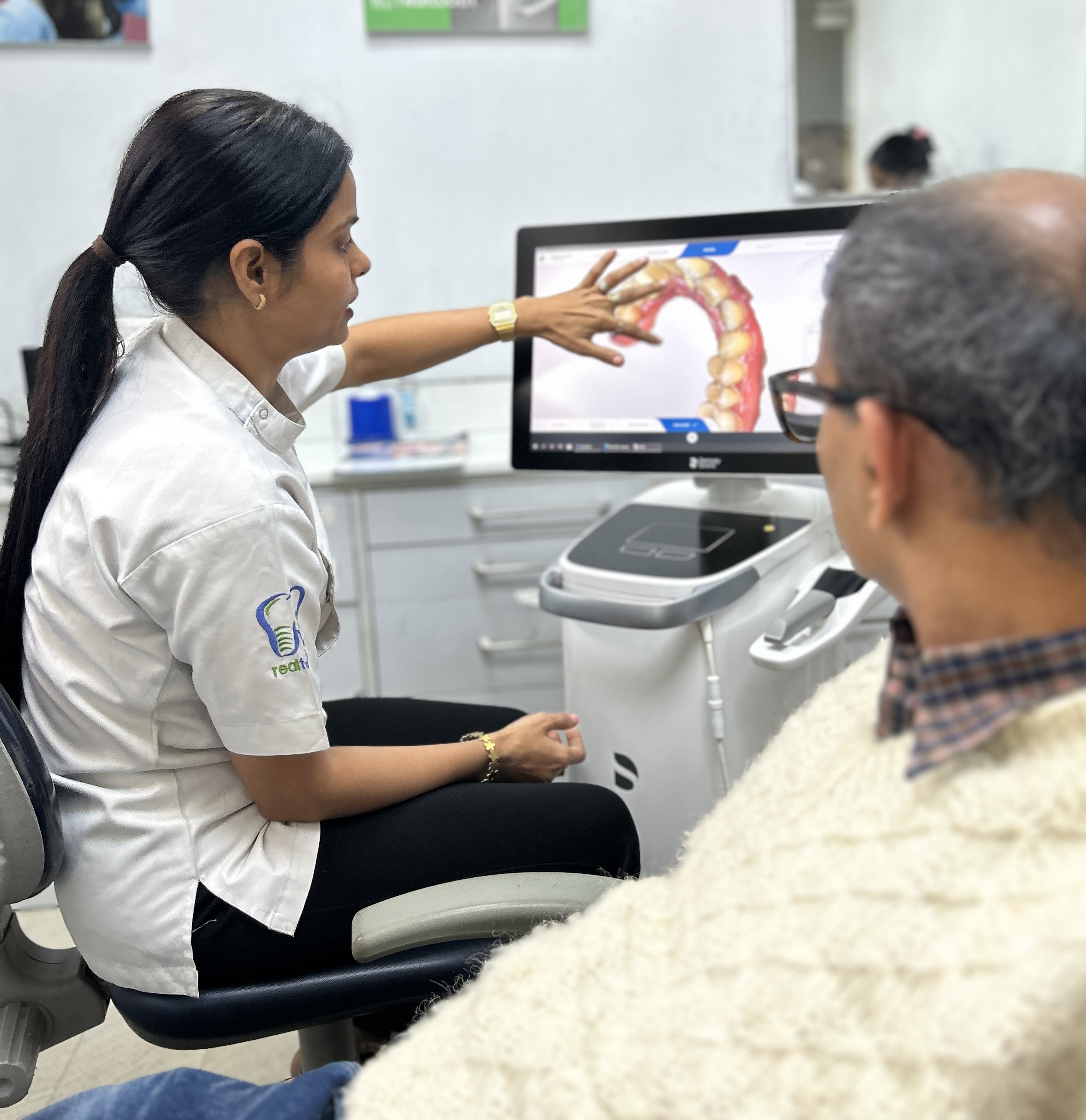
CBCT (Cone Beam Computed Tomography) may be advised when the dentist needs a precise three-dimensional view.
CBCT provides detailed 3D evaluation of:*This can be especially useful in selected wisdom tooth and complex surgical extraction cases.
The goal is not to use more technology. It is to understand the anatomy before surgery when that primaryrmation matters.
Realtooth USP: Oral Surgery Expertise
Simple and complex extractions are not the same procedure.
Realtooth's multispeciality structure allows more difficult cases to be managed with the appropriate level of oral surgical expertise.
check case. check clinician. check surgical approach.
Our Goal: Atraumatic Extraction Where Possible
When a tooth must be removed, preserving surrounding tissues can be critically important—especially when future implant or restorative treatment is being considered.
The surgical team may aim to preserve:
Particularly relevant when the treatment plan may later involve:
How a tooth is removed can directly influence what treatment options remain available afterwards.
Extraction and Future Dental Implants
If an implant may be required later, it is useful to consider this before the tooth is extracted whenever possible.
Possible approaches include:
Immediate Implant After Extraction
An implant can sometimes be placed at the same appointment as tooth removal.
At Realtooth: Fewer appointments are useful only when the clinical conditions support them.
Socket Preservation After Extraction
After a tooth is removed, bone naturally changes during the healing process.
In selected cases, socket-preservation or bone-grafting procedures may be considered to help maintain bone volume for future restorative treatment.
This may be particularly relevant when:Note: Not every extraction requires bone grafting—we evaluate on a case-by-case basis.
Front Tooth Extraction
Extraction of a front tooth requires special planning because of:
- How will you look immediately afterwards?
- Can a temporary tooth be provided?
- Is immediate implant placement appropriate?
- How can gum and bone best be preserved?
Multiple Tooth Extractions
Some patients require several teeth to be removed because of:
- Advanced gum disease
- Severe decay
- Failed restorations
- Full-mouth rehabilitation
In such cases, treatment should not consist of simply extracting teeth one by one without a larger plan.
Realtooth may first determine:Multiple extractions should form part of a rehabilitation plan—not become the entire plan.
Tooth Extraction Before Orthodontics
In some orthodontic cases, extraction may be recommended to create space or improve the bite. This decision must be fully coordinated with the overall orthodontic treatment plan.
Key factors evaluated during planning:Teeth should never be removed for orthodontic reasons without a clear overall treatment strategy.
What Happens During Tooth Extraction at Realtooth?
Diagnosis
The dentist evaluates why the tooth is causing a problem and whether it can be saved.
Imaging When Required
Depending on the case, imaging may be advised:
Treatment Planning
We evaluate key factors to plan treatment:
Anaesthesia
Appropriate local anaesthesia is used to make the procedure as comfortable as possible.
Tooth Removal
The tooth is removed using a technique appropriate to its anatomy and condition.
Socket Management
The extraction site is cleaned and assessed, which may involve:
Post-Operative Instructions
Patients receive comprehensive guidance regarding:
Follow-Up
More complex surgical cases may require review and suture removal.
Is Tooth Extraction Painful?
The extraction itself is generally performed under local anaesthesia.
Patients may feel pressure during the procedure, but sharp pain should be controlled.
may occur depending on the complexity of the extraction.
Surgical extractions may require a longer recovery than simple extractions.
What Should I Expect After Extraction?
A blood clot forms in the socket and is an important part of healing. Patients are usually advised to follow post-operative instructions carefully to protect the site.
What Is Dry Socket?
Dry socket can occur when the blood clot within an extraction socket is lost or breaks down prematurely.
It requires professional assessment and local treatment. Smoking and traumatic disturbance of the socket can increase risk.
- Increasing pain several days after extraction
- Pain radiating toward the ear or jaw
- Unpleasant taste or smell
When Should You Contact Us After Extraction?
Contact the Realtooth team immediately if you experience any of the following symptoms:
What Should I Expect After Extraction?
A blood clot forms in the socket and is an important part of natural healing.
Patients are usually advised to follow post-operative instructions carefully to protect the site:
- Avoid vigorous rinsing initially
- Avoid disturbing the socket area
- Follow soft-diet instructions
- Maintain oral hygiene as advised
- Avoid smoking or tobacco use
- Take medication only as directed
- Contact the clinic if symptoms become unusual or severe
Proper post-operative care helps ensure smooth recovery and prevents complications like dry socket.
What Is Dry Socket?
Dry socket can occur when the blood clot within an extraction socket is lost or breaks down prematurely.
Common Symptoms Include:
- Increasing pain several days after extraction
- Pain radiating toward the ear, temple, or jaw
- Unpleasant taste or bad breath (foul odor)
Risk Factors:
Smoking, tobacco use, and traumatic or physical disturbance of the socket can significantly increase the risk.
Dry socket requires professional clinical assessment and local treatment for prompt pain relief.
When Should You Contact Us After Extraction?
Please contact the Realtooth team immediately if you experience any of the following warning signs:
- Persistent heavy bleeding
- Increasing facial or gum swelling
- Fever or elevated temperature
- Severe or worsening pain
- Difficulty swallowing
- Difficulty breathing
- Persistent numbness in lips/jaw
- Pus or significant discharge
- Other symptoms causing concern
What Happens to the Gap After Extraction?
Not every removed tooth needs replacement (for example, wisdom teeth generally do not). However, when a functional tooth is removed, leaving the space untreated may contribute to:
Impact of Leaving a Gap:
- Movement or drifting of neighbouring teeth
- Bite changes and misalignment
- Over-eruption of the opposing tooth
- Reduced chewing efficiency
- Jaw bone loss or structural changes
- Aesthetic and smile concerns
Replacement Options Include:
- Dental Implant: Long-term fixed root replacement
- Dental Bridge: Fixed option supported by adjacent teeth
- Removable Denture: Convenient removable prosthesis
- Implant-Supported Restoration: Advanced multi-tooth solution
The best tooth replacement option depends on your specific clinical situation and tooth location.
Realtooth USP: Extraction & Replacement Under One Treatment Plan
One major advantage of Realtooth's multispeciality model is that extraction does not need to be planned in isolation.
When appropriate, your case involves a collaborative team of experts:
This helps answer the vital question: “What should happen after the tooth is removed?” — long before surgery even begins.
When Should You Ask for a Second Opinion?
Consider seeking a second opinion if you have been advised:
- Extraction of a front tooth
- Removal of multiple teeth
- Extraction before implant treatment
- Removal of a root canal-treated tooth
- Full-mouth extraction
- Extensive wisdom tooth surgery
- Tooth removal despite minimal symptoms
A second opinion can provide clarity on whether:
Why Choose Realtooth for Tooth Extraction?
Comprehensive, conservative, and digitally planned dental care.
Tooth Preservation First
We evaluate whether the natural tooth can reasonably be saved before recommending removal.
Digital Imaging
X-rays, OPG, and CBCT are available when required for precise diagnosis and surgical planning.
Oral Surgery Expertise
More complex extractions are managed safely with specialized surgical expertise.
Atraumatic Philosophy
Where possible, we aim to preserve surrounding bone and soft tissue for faster healing.
Implant Planning Integration
Extraction can be coordinated with future implant placement or immediate implant treatment in suitable cases.
Bone-Preservation Options
Socket-preservation procedures can be considered where clinically beneficial.
Multispeciality Team
Complex cases involve restorative, endodontic, surgical, and implant expertise under one roof.
Replacement Planning
We help you understand if the missing tooth needs replacement and compare appropriate options.
Extraction vs Saving the Tooth
| Situation | Possible Direction |
|---|---|
| Deep decay but restorable tooth | Filling / RCT / Crown may be considered |
| Failed RCT but adequate tooth structure | Retreatment may be possible |
| Vertical or non-restorable fracture | Extraction may be required |
| Advanced periodontal bone loss | Prognosis determines treatment |
| Impacted wisdom tooth causing disease | Surgical removal may be appropriate |
| Healthy tooth needed for orthodontic plan | Extraction only after coordinated planning |
The final decision requires individual assessment.
Frequently Asked Questions
What Determines Tooth Extraction Cost?
The cost can depend on:
- Tooth involved
- Simple vs surgical extraction
- Root anatomy
- Impaction
- Need for specialist surgery
- Imaging required
- Bone grafting
- Socket-preservation procedures
- Additional treatment
A personalised treatment recommendation and estimate are provided after clinical evaluation.
₹ 800 onwards
₹ 2,500 onwards
₹ 4,500 onwards
₹ 5,000 onwards
Don't Ask Only: How Quickly Can This Tooth Be Removed?
These questions often have more impact on your long-term dental health than the extraction itself.
Important Questions to Ask Before Treatment:
- Can the tooth still be saved?
- Why does it need extraction?
- Is surgery required?
- Will bone be preserved?
- Do I need a replacement?
- Can an implant be planned now?
- Will I need a temporary tooth?
- What happens if I leave the space?
Been Told You Need a Tooth Removed?
Let the Realtooth team first determine whether the tooth is: Saveable or Better Removed.
If extraction is necessary, we can help plan the procedure and what should happen afterwards.