TMJ Disorders & Jaw Pain at Realtooth
Jaw Pain Is Not Always a “Bite Problem.” Start With the Right Diagnosis.
Pain near the jaw joint, clicking while opening the mouth, difficulty chewing, jaw stiffness or recurring facial pain can sometimes be related to a temporomandibular disorder (TMD).
The temporomandibular joint—commonly called the TMJ—is the joint located in front of each ear that connects the lower jaw to the skull.
“TMD” is actually an umbrella term covering more than 30 conditions involving the jaw joints, chewing muscles and related structures. At Realtooth, we do not assume every patient with jaw pain has the same problem.
Our Diagnostic Pathway:Understand the Pain Examine Joint & Muscles Evaluate Dental Factors Identify Habits Selective Imaging Start Conservatively Review Response
TMJ care should begin with understanding the problem—not permanently changing the teeth or bite.
TMJ or TMD—What's the Difference?
These terms are often used interchangeably, but they refer to different aspects of jaw health.
TMJ
TMJ means temporomandibular joint the actual jaw joint. You have one on each side connecting your lower jaw to your skull.
TMD
TMD means temporomandibular disorder and refers to conditions affecting the jaw joint, chewing muscles, and associated structures.
TMD can involve the joint, the surrounding muscles, or sometimes both components at the same time.
What Does the TMJ Do?
Unlike a simple hinge, the TMJ performs a combination of rotation and sliding movements, making it one of the most complex joint systems in the body.
Your temporomandibular joints are actively involved in essential everyday functions. When the joint or associated muscles become painful or dysfunctional, these simple activities can become very uncomfortable.
Clinical Insight
Because of its continuous daily use during eating and speaking, proper functioning of the TMJ is critical to your quality of life.
The TMJ is active every time you:
- Open your mouth
- Close your mouth
- Chew food
- Speak
- Yawn
- Move jaw side-to-side
Common Symptoms of TMD
Symptoms vary significantly between patients depending on whether the joint, muscle, or both are involved.
Pain & Mobility Issues
Discomfort in the jaw joint area often radiates into nearby muscles and restricts normal jaw movement.
Common complaints include:- Pain around the jaw joint or in chewing muscles
- Pain while chewing food
- Jaw stiffness or reduced mouth opening
- Difficulty opening the mouth or complete jaw locking
- Pain spreading into the face or neck
Joint Sounds & Bite Changes
Mechanical changes within the joint space can produce audible sounds and alter how your upper and lower teeth meet.
Common complaints include:- Painful clicking or popping sounds
- Grinding or grating sensations (crepitus)
- A sudden change in the way teeth fit together
- Fatigue in facial muscles during chewing
TMD-related symptoms can overlap with other conditions, so jaw or facial pain should not automatically be labelled as TMJ disease without clinical evaluation.
My Jaw Clicks Do I Need Treatment?
Not necessarily, This is an important distinction
Jaw clicking or popping without pain is common and often does not require treatment.
- Pain
- Jaw locking
- Restricted opening
- Change in jaw movement
- Difficulty eating
- Recent trauma
- Progressive worsening
“We don't treat sounds. We treat clinically meaningful problems.”
What Causes TMJ Disorders?
There is no single cause of TMD. In many patients, several biological, behavioural, and pain-related factors may contribute.
Trauma to the jaw can cause some TMDs, but many cases begin without an obvious single trigger. Potential contributing factors considered during assessment may include:
The important principle: Different causes require different treatment strategies.
Is a "Bad Bite" the Cause of TMJ Problems?
This area deserves particular caution. Current evidence does not support the common belief that malocclusion ("bad bite") or orthodontic treatment such as braces generally causes TMD.
That means TMJ symptoms should not automatically lead to:
- Grinding down healthy teeth
- Placing crowns simply to change the bite
- Orthodontic treatment solely to "cure TMJ"
- Permanent bite alteration
The U.S. National Institute of Dental and Craniofacial Research specifically advises caution with irreversible treatments that permanently change teeth, bite or jaw structures for TMD management.
Realtooth's Position
We may evaluate the bite as part of the complete dental examination, particularly when patients report tooth wear, grinding, or a recent change in how their teeth meet. But:
Examining the bite is different from assuming the bite is the cause.
This distinction protects patients from unnecessary, irreversible dentistry.
Realtooth USP: Diagnosis Before Treatment
Jaw pain can arise from many sources. Since there is no single standard test that diagnoses all TMDs, and symptoms may overlap with other conditions, a thorough clinical evaluation is essential before recommending treatment.
Before recommending treatment, we try to understand:
Where is the pain and when did it begin?
Is the pain muscular or joint-related?
Is there clicking, locking, or limited opening?
Is pain associated with chewing, grinding, or clenching?
Has there been any recent or past injury to the jaw?
Are dental infections, wisdom teeth, or other conditions mimicking TMD?
This thorough process prevents misdiagnosis and protects you from unnecessary dental procedures.
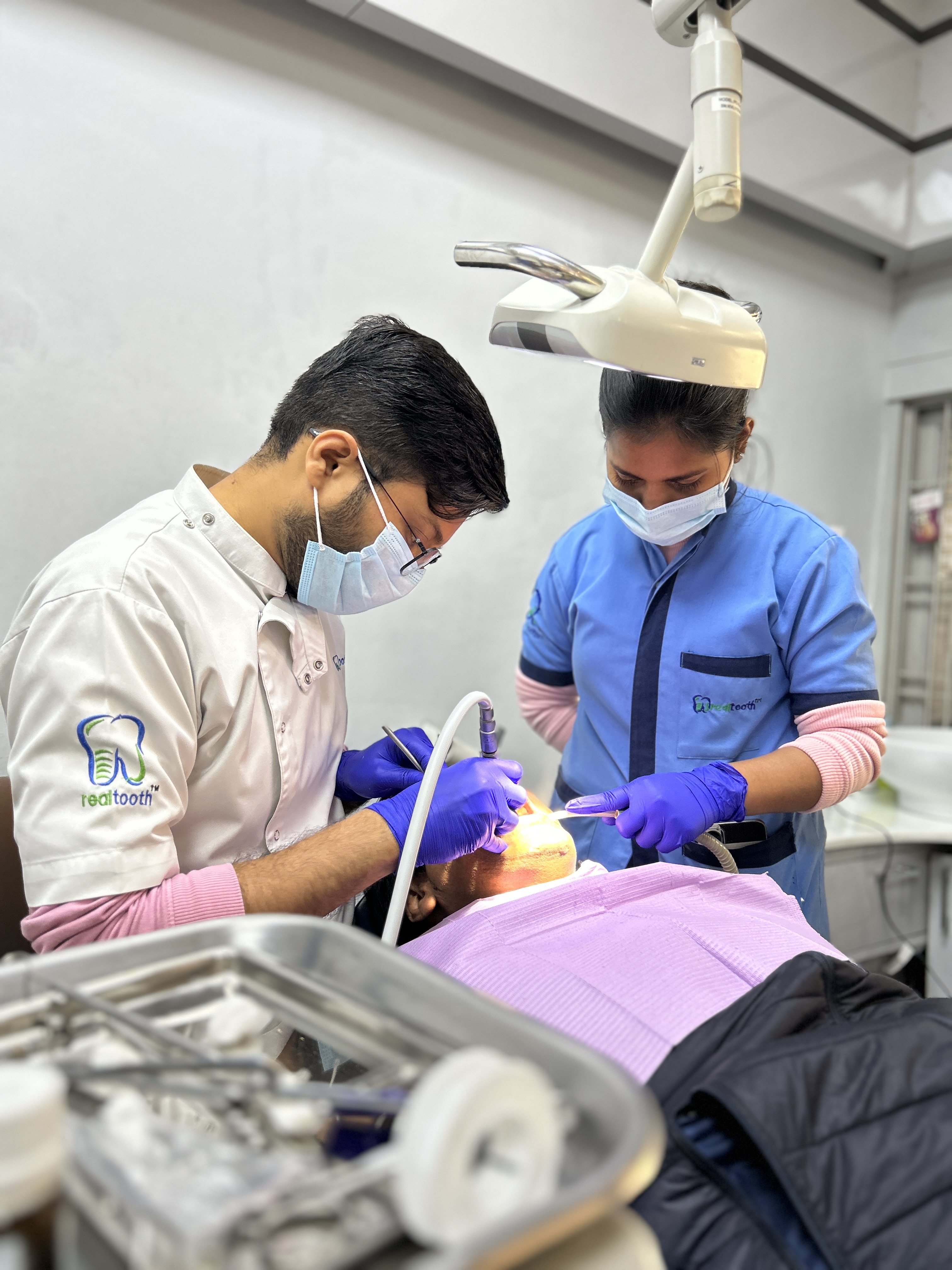
What Happens During a Realtooth TMJ Assessment?
Depending on your symptoms, our comprehensive assessment may involve several key components:
1. Detailed History
Understanding the history often provides as much information as imaging. We ask about:
- Location, duration & severity
- Triggers & time pattern (Morning vs Evening)
- Jaw locking, clicking, grinding or clenching
- Trauma & previous dental treatments
- Headache, sleep symptoms & stress patterns
2. Jaw Movement Assessment
The objective is to understand how the jaw is functioning—not simply whether a sound exists. We evaluate:
- Mouth opening & closing patterns
- Side-to-side movement & deviation
- Range of movement & locking
- Joint sounds and mechanics
3. Muscle Assessment
Pain may come predominantly from muscles rather than the joint. Chewing muscles are examined for:
- Tenderness & tension
- Reproduction of familiar pain
- Functional discomfort
- Distinguishing muscle vs. joint problems
4. Dental Examination
The purpose is to identify dental consequences or alternative causes of pain—not to automatically blame the bite. We assess:
- Tooth wear & cracked teeth
- Broken restorations
- Missing teeth
- Existing crowns/implants
- Grinding patterns
- Areas of excessive contact
5. Imaging When Clinically Required
Most patients do not need every available scan. Imaging should answer a specific clinical question. Depending on symptoms, conventional X-rays, CT/CBCT, or MRI may be recommended.
Realtooth USP: Digital Imaging When It Adds Value
Realtooth has access to advanced dental diagnostic imaging. However, the right scan is the one that answers the clinical question—more imaging is not automatically a better diagnosis.
Dental X-Rays / OPG
Provides useful information about:
- Teeth & jaws
- Wisdom teeth
- General bony structures
- Other dental causes of pain
3D CBCT
Useful for 3D bony anatomy evaluation to assess:
- Joint-related bony structures
- Jaw anatomy & pathology
- Impacted teeth & structural issues
*Not automatically required for every clicking or jaw pain.
MRI
Recommended through an appropriate imaging facility or specialist pathway when detailed evaluation of joint soft tissues or internal joint structures is required. Used in selected TMD evaluations.
The right scan is the one that answers the clinical question. More imaging is not automatically better diagnosis.
Realtooth Treatment Philosophy: Conservative First
Many TMD symptoms improve with time. Current expert guidance recommends starting with simple, conservative, and reversible approaches before considering permanent changes or surgery.
Diagnose
Thorough evaluation to pinpoint the exact root cause of discomfort.
Educate
Helping patients understand their condition and behavioral drivers.
Reduce Overload
Strategies and modifications to relieve excessive joint and muscle stress.
Conservative Self-Care
Non-invasive self-management protocols and gentle guidance.
Physiotherapy / Medical Management
Appropriate targeted physical therapy or medical therapy when required.
Custom Appliance in Selected Patients
Splints or oral appliances custom-fitted only when specifically indicated.
Review
Monitoring progress and assessing improvement over time.
Specialist / Surgical Evaluation
Only evaluated when indicated for advanced or non-responsive cases.
The objective is to use the least invasive treatment capable of helping the patient.
Conservative TMJ Care
Depending on diagnosis, initial management may involve simple, non-invasive first-line measures to help relieve jaw discomfort and support long-term joint health.
Depending on diagnosis, initial management may involve measures such as:
- Temporarily choosing softer foods
- Avoiding excessive chewing
- Reducing gum chewing & nail biting
- Becoming aware of daytime clenching
- Heat or cold application in selected situations
- Gentle jaw exercises when appropriately instructed
- Short-term medication when medically appropriate
- Self-management strategies
Note: These are among the simple first-line approaches highlighted by NIDCR for many TMD presentations. Treatment should still be personalised rather than copied from an online exercise programme.
Teeth Grinding, Clenching & TMJ Symptoms
Some patients with jaw discomfort also grind or clench their teeth during day or night.
Possible signs include:
Grinding and TMD should not automatically be considered the same condition.
The treatment plan should identify: What is causing pain? and separately: What needs protection from excessive forces?
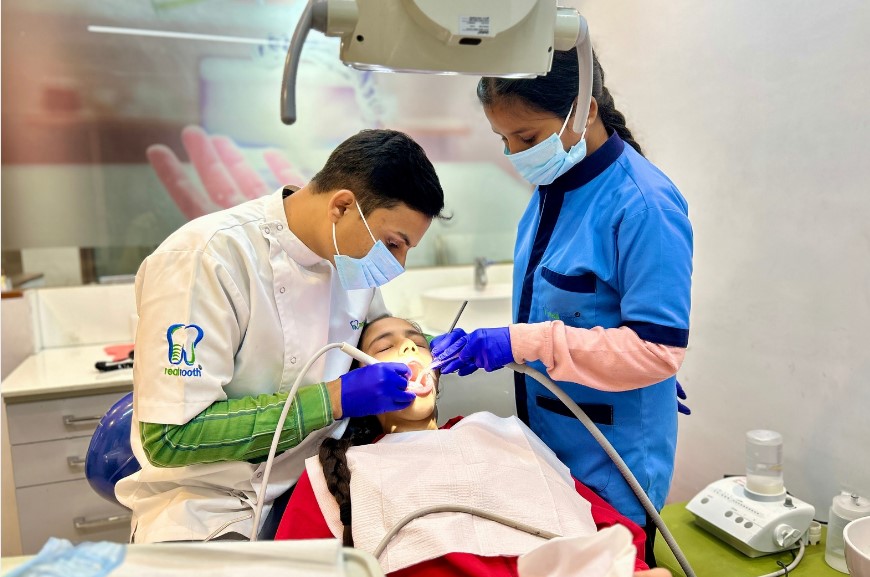
Custom-Made Splints / Nightguards at Realtooth
In selected patients, an intraoral appliance may be considered as part of a personalized management protocol.
These appliances are sometimes called:
Such appliances can protect teeth and may help some patients with habit-related jaw loading, but evidence that they consistently relieve TMD pain is limited. They should not be designed to permanently change the patient's bite.
This is an important Realtooth distinction: We do not position a splint as a guaranteed “TMJ cure.” Instead, when appropriate, it may be used as part of a broader conservative management strategy.
Realtooth USP: Digitally Customised Appliances
When a custom appliance is indicated, Realtooth's digital dentistry capabilities allow maximum precision and comfort.
Our digital dentistry workflow includes:
Intraoral digital scanning
Digital dental records
Bite records
CAD-based appliance planning
Custom manufacturing workflows
Advantage: The appliance can therefore be designed around the patient's actual: Teeth + Existing Restorations + Dental Arch + Functional Requirements, rather than relying on a generic over-the-counter guard.
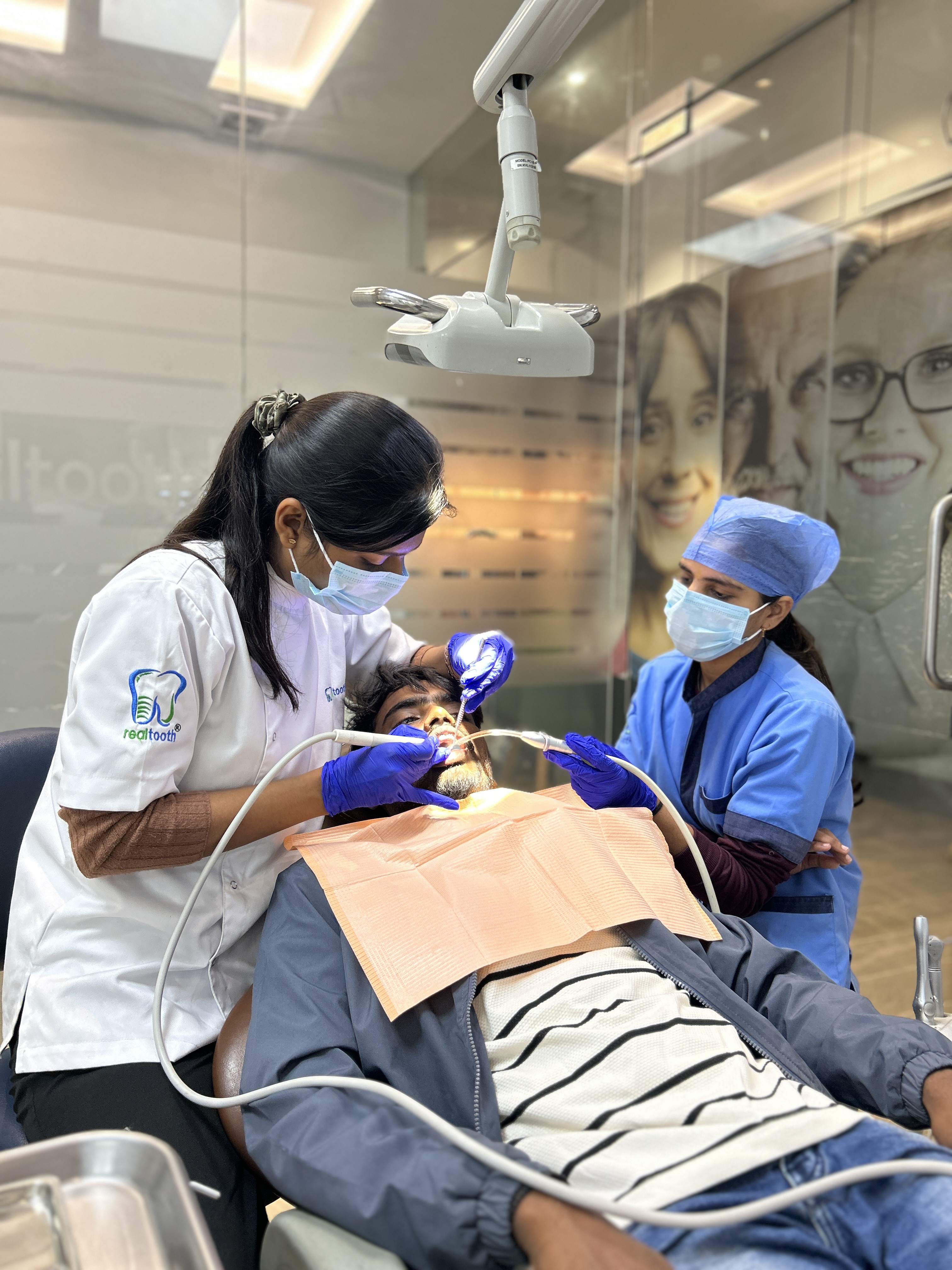
TMJ Symptoms & Extensive Dental Work
Patients with extensive restorations may also develop muscle fatigue, grinding, or jaw symptoms. The correct response should not automatically be to remake the dentistry.
Common in patients with existing restorations such as:
At Realtooth, we first thoroughly evaluate:
- Symptom Timeline: When the jaw symptoms first began.
- Dental Involvement: Whether new dental work is actually involved.
- Muscle & Joint Health: Muscle symptoms and joint condition.
- Occlusion: Tooth contacts and bite relationships.
- Restoration Integrity: Overall quality of existing restorations.
- External Factors: Other contributing systemic or habits-related factors.
A temporal association does not automatically prove a dental cause. Diagnosis still matters.
Physiotherapy & TMJ Care
Physical therapy can play an important role in selected TMD patients. NIDCR notes that manual physical therapy
may help improve jaw function and relieve pain in appropriate cases.
Realtooth Targeted Physiotherapy Focus Areas:
Jaw Mobility
Muscle Function & Exercises
Habit Awareness
Neck & Musculoskeletal Function
TMD care can sometimes require collaboration beyond dentistry.
"Proper physical therapy helps restore natural mobility and reduce pain effectively."
Stress, Clenching & Jaw Locking
Understanding jaw symptoms, behavioral triggers, and functional limits ensures accurate non-invasive management.
Stress, Clenching & Muscle Tension
Stress does not mean jaw pain is "just psychological." However, behavioral factors directly influence muscle tension, clenching, and pain perception.
Self-management, relaxation approaches, and behavioral interventions form an essential part of TMD treatment.
Pain is real. Understanding every contributor gives us more ways to manage it.
When Your Jaw Locks: Immediate Assessment
Jaw locking can occur in different situations (jaw stuck closed, stuck open, or catching). Assessment is crucial when associated with:
Treatment depends on the underlying cause rather than the symptom alone.
TMJ and Headaches
TMD can sometimes be associated with headaches, but headaches also have many other potential causes. If headache is a major or unusual symptom, broader medical assessment may be appropriate.
Our Patient-Centric Approach:
Realtooth avoids presenting every headache as a dental or TMJ problem. That protects patients from unnecessary dental intervention.
TMJ Pain and Ear Symptoms
Because the TMJ lies close to the ear, some patients with TMD report symptoms such as:
Such symptoms can occur with TMD, but ear symptoms may also have non-dental causes. Persistent or significant symptoms may therefore require evaluation by an appropriate medical professional.
When Your Jaw Locks
Jaw locking can occur in different situations. Proper evaluation ensures target-driven care.
Common Patient Reports
- Jaw stuck closed
- Difficulty opening fully
- Jaw occasionally catches
- Jaw becoming stuck open
Requires Urgent Assessment If Accompanied By:
- Pain
- Trauma
- Sudden functional limitation
- Repeated locking
The treatment depends on the underlying cause rather than the symptom alone.
Do I Need Surgery for TMJ Disorder?
More invasive procedures may be considered only for selected diagnoses and persistent significant symptoms. These can include specialist procedures such as:
AAOMS also recognises both non-surgical and surgical approaches to intra-articular TMJ disease, with contemporary management emphasising appropriate patient selection rather than routine surgery.
Most patients should not begin with surgery. Current guidance strongly favours simpler and reversible approaches first because many TMD symptoms may improve without invasive treatment.
Conservative First Approach
Invasive surgical options are reserved exclusively for severe, non-responsive intra-articular cases after conservative treatments have been thoroughly explored.
Realtooth USP: Specialist Referral & Diagnosis
TMD crosses multiple areas of healthcare. Our role is to identify the exact source of pain and connect you with the right expertise.
Multidisciplinary Specialist Input
Depending on diagnosis, complex TMD cases may require input beyond general dentistry:
Realtooth ensures seamless referral when specialized care is needed.
TMJ Disorder or Dental Pain?
Some dental conditions closely mimic jaw-joint discomfort. A comprehensive exam determines if the origin is dental:
- Tooth infection / Dental abscess
- Cracked tooth or restoration issues
- Impacted wisdom tooth problems
- Advanced gum disease
Proper evaluation rules out common tooth issues before treating TMJ.
Right Diagnosis. Right Clinician. Right Stage of Treatment.
What About Botox® for TMJ Pain?
Evaluating non-routine injection therapies with clinical evidence.
Botulinum toxin is sometimes promoted for TMD-related muscle symptoms. However, NIDCR notes that evidence for botulinum toxin Type A in TMD remains mixed and its effectiveness for TMD pain is still unclear.
Realtooth does not position injections as a routine first-line solution for every patient with jaw pain. Diagnosis and conservative treatment should always come first.
Treatments We Approach With Caution
Patients with chronic jaw pain are sometimes offered aggressive or irreversible treatments very early.
Realtooth believes caution is appropriate before using TMD as a reason for irreversible changes.
Procedures Requiring High Caution:
- Grinding healthy teeth
- Extensive crowns solely to alter the bite
- Orthodontic treatment solely to "correct TMJ"
- Permanent bite changes
- Surgical joint treatment without adequate conservative care
Clinical Evidence & Guidance:
NIDCR specifically notes insufficient evidence for occlusal treatments intended to treat TMD and warns that they can sometimes make symptoms worse.
Irreversible dentistry should require a strong dental indication of its own — not simply a vague promise of curing jaw pain.
Note: Reversible, conservative management remains the gold standard before considering permanent dental alterations.
The Realtooth TMJ Care Journey
Understand the Problem
We listen attentively to your complete history:
Clinical Assessment
We thoroughly examine:
Rule Out Other Dental Causes
We investigate whether pain could be coming from non-TMJ issues:
Imaging Only if Indicated
Depending on the diagnostic question, we may consider:
Explain the Diagnosis
We ensure you understand whether the problem appears mainly related to:
Begin Conservatively
Initial management focuses on non-invasive and reversible strategies wherever appropriate.
Custom Appliance if Indicated
When a protective or stabilisation appliance has a clear role, it is individually designed for fit and comfort.
Physiotherapy / Multidisciplinary Care
Additional professional care (physiotherapy, medical or behavioral management) is incorporated when indicated.
Review Response
TMD care requires ongoing reassessment and adjustment rather than a single procedure followed by discharge.
Escalate Only When Necessary
Persistent or structurally complex cases can be referred for appropriate specialist or surgical evaluation.
FAQs
What Determines the Cost of TMJ Assessment & Treatment?
Cost depends on what is actually required.
TMJ Assessment & Treatment May Include:
- TMJ / Jaw Pain Consultation
- Digital Dental Assessment
- OPG / CBCT When Indicated
- Custom Digital Splint / Protective Appliance
- Specialist / Multidisciplinary Care
The assessment and treatment approach depends on the symptoms, clinical findings, diagnostic requirements and individual treatment needs.
A treatment plan is recommended only after appropriate assessment.
₹ 500
₹ 1000
₹ 700
₹ 6,000 onwards
Specialist / Multidisciplinary Care
According to treatment requirement
A treatment plan is recommended only after appropriate assessment.
Before You Agree to Permanent TMJ Treatment Ask These Questions
These questions can protect patients from unnecessary, irreversible procedures.
- • What exactly is my diagnosis?
- • Is my problem in the muscle, the joint, or somewhere else?
- • Does painless clicking actually require treatment?
- • Why is my bite being blamed?
- • Can we start with reversible treatment?
- • Do I really need a splint?
- • Will this appliance permanently change my bite?
- • Why do I need this scan?
- • Are crowns or orthodontics really necessary?
- • Have simpler treatments been tried first?
- • Should I get a second opinion before surgery?
These questions can protect patients from unnecessary treatment. At Realtooth, we help you answer them before deciding on care.
Jaw Clicking, Jaw Pain or Difficulty Opening Your Mouth?
Don't begin by trying to “correct your bite.” Begin by understanding what is actually causing the problem.