Blog
Dental Treatment in India: Guide for International Patients
Coming to India for Dental Treatment? Plan Before You Board the Flight
There is a conversation we have surprisingly often with our NRI patients:
“Doctor, I'm coming to Lucknow for three weeks. I need to get my teeth sorted while I'm there.”
Then comes the list—an old crown, a filling, whitening before a wedding, perhaps a missing tooth. And somewhere between meeting family, attending functions, travelling and recovering from jet lag, they hope to fit dentistry in too. It can be done, but the smartest way to manage dental treatment during a short India visit is not to start planning after you arrive.
For NRI patients, time is often the biggest constraint
The challenge isn't necessarily how much dental treatment is required. It is how that treatment fits into a limited travel window. Some procedures can be completed in one or two appointments, while others require healing time, lab work or multiple stages. Implants, crowns, root canals, cosmetic dentistry—all have their own timelines. Trying to squeeze everything into the final few days of a trip puts unnecessary pressure on both patient and clinical team. Good dentistry should be efficient, not rushed.
Start the conversation before you travel
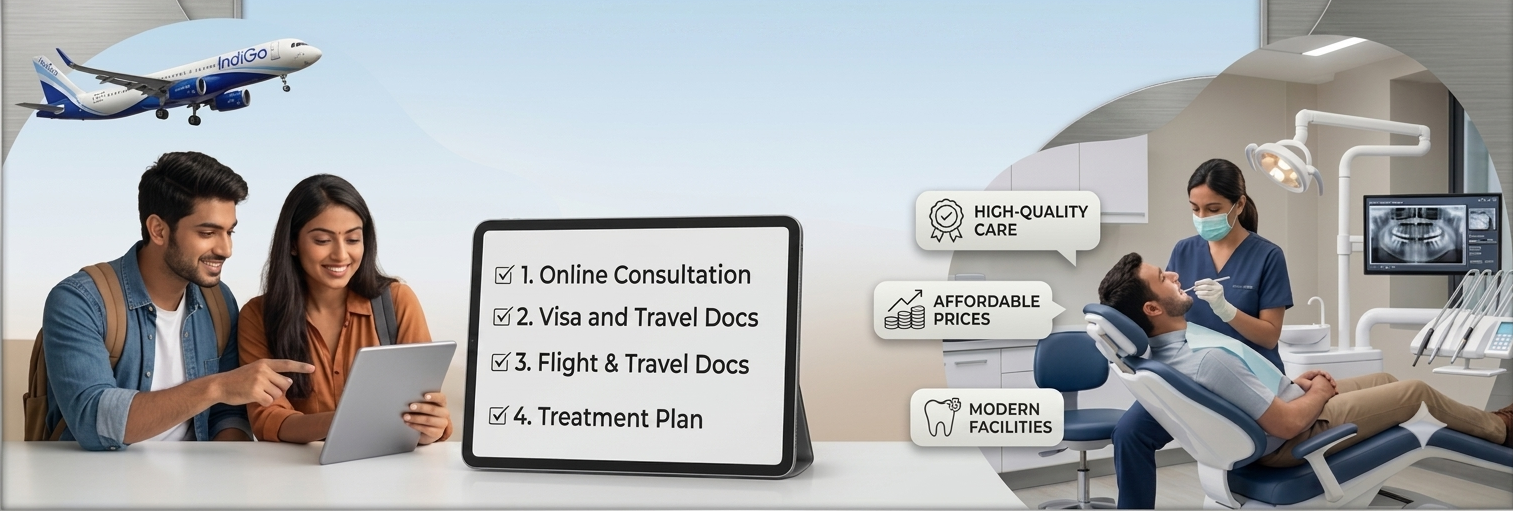
This is probably the single most useful thing an NRI patient can do. If possible, connect with your dentist before booking your dental treatment dates. A video consultation, along with recent X-rays or clear photographs, can give the dentist a useful starting point. Most importantly, share your exact travel dates. Knowing you are in Lucknow from, say, December 15 to January 5, allows appointments to be planned differently.
Sequence treatment, don't just schedule appointments
Procedures that need healing or multiple stages should be assessed early in the trip. Treatments that can be completed predictably in a shorter window can be planned accordingly. Cosmetic procedures—especially for weddings or family functions—should be timed with the event in mind. The right question is not “How much dentistry can we fit into three weeks?” but “What should we complete during these three weeks, and what should we not rush?”
Digital dentistry has made short visits easier
CBCT imaging, intraoral scanners, digital planning and modern workflows have genuinely changed the experience for travelling patients. In suitable cases, digital workflows can reduce turnaround time for restorations. But technology’s real value is making treatment better planned, more precise and more predictable.
Don't try to fix everything simply because you're in India
Sometimes NRI patients arrive with a long dental wish list and a short calendar. The right answer isn’t always to do everything. If a procedure requires more healing time or follow-up than the travel schedule allows, it may be better to complete one stage now and plan the next appropriately. Your dentist should be comfortable telling you what can be completed safely—and equally comfortable telling you what should wait.
Before flying back, take your dental records with you
If you've undergone significant treatment, ask for copies of relevant scans, X-rays and treatment information. Good documentation makes continuity of care much easier when your dentist abroad needs to follow up.
What we do differently for NRI patients at Realtooth
Over the years, we have realised that NRI patients don’t necessarily need faster dentistry. They need better-coordinated dentistry. At Realtooth, we encourage patients travelling to Lucknow to connect with us before their trip. Once they arrive, clinical examination and digital diagnostics help finalise the treatment plan, and appointments are sequenced around both clinical requirements and travel schedule. Having different dental specialties and digital workflows within the same ecosystem also makes coordination easier.
But there is one thing I would tell every NRI patient planning dental treatment in India:
Don’t make your dentist the last appointment you book. Speak to them while you’re still planning your trip. Because the goal shouldn’t be to spend your India visit sitting in a dental chair. The goal should be to get the dentistry you genuinely need done well—and still have enough time left for the people you actually came home to see.